
Every four years or so, without anyone flipping a switch or holding a vote, the Bitcoin network quietly cuts in half the number of new bitcoins it creates. That event is the halving, and it’s one of the few genuinely hard-coded, predictable mechanics in an asset otherwise known for volatility. It’s also become one of the most-watched dates on the crypto calendar, because every one of the four halvings so far has been followed, at some point in the following year or two, by a major bull run — though whether the halving causes that, or just coincides with it, is exactly where the debate lives.
This article is for informational and educational purposes only. It is not financial advice, investment advice, or a recommendation to buy, sell, or hold any security, cryptocurrency, or financial product. Always verify data with official sources before making financial decisions.
Quick answer: what is Bitcoin halving?
Bitcoin halving is a built-in event, occurring roughly every four years (every 210,000 blocks mined), that cuts the “block reward” — the number of new bitcoins paid to miners for confirming transactions — exactly in half. It has happened four times: in 2012, 2016, 2020, and 2024, taking the reward from 50 BTC down to 25, then 12.5, then 6.25, and now 3.125 BTC per block. Halving matters for price because it directly slows the rate at which new bitcoin supply enters circulation, while it does nothing on its own to change demand — a supply shock that, historically, has often preceded major price cycles, even though macro conditions, adoption, and market sentiment all move at the same time and make it hard to credit the halving alone.
How Bitcoin halving actually works
Bitcoin’s protocol releases new coins into circulation as a reward paid to miners each time they successfully add a new block of transactions to the blockchain. When Bitcoin launched in January 2009, that reward was set at 50 BTC per block. Built into the code from the very beginning was a rule: every 210,000 blocks — which works out to roughly four years, since a new block is mined on average every ten minutes — that reward automatically cuts in half.
This isn’t a decision anyone makes in real time. It’s not a vote, a Fed-style meeting, or a company policy that could be reversed. It’s a rule embedded in the software that every participant on the network runs, and it only changes if an overwhelming share of the network agreed to modify it — something that has never happened and isn’t something any single party can unilaterally do. That’s the core reason halving gets so much attention: it’s one of the few dates in the entire crypto calendar where the exact effect on new supply is knowable years in advance, in an asset class not otherwise known for that kind of certainty.
The halving schedule is also why Bitcoin has a hard cap of 21 million coins that will ever exist. Because the reward keeps cutting in half roughly every four years, the amount of new bitcoin issued shrinks geometrically over time, and the math works out so that the supply approaches — but never quite reaches — 21 million, with the final fractional satoshis expected to be mined around the year 2140.
Every Bitcoin halving so far
Four halvings have happened to date. Each one is tied to a specific block height, since the trigger is the block count, not the calendar date — the roughly four-year gap is simply what ten-minute average block times work out to over 210,000 blocks.
| Halving | Date | Block height | Reward before | Reward after |
|---|---|---|---|---|
| Genesis (network launch) | January 3, 2009 | 0 | — | 50 BTC |
| 1st halving | November 28, 2012 | 210,000 | 50 BTC | 25 BTC |
| 2nd halving | July 9, 2016 | 420,000 | 25 BTC | 12.5 BTC |
| 3rd halving | May 11, 2020 | 630,000 | 12.5 BTC | 6.25 BTC |
| 4th halving | April 19–20, 2024 | 840,000 | 6.25 BTC | 3.125 BTC |
| 5th halving (expected) | ~2028 | 1,050,000 | 3.125 BTC | 1.5625 BTC |
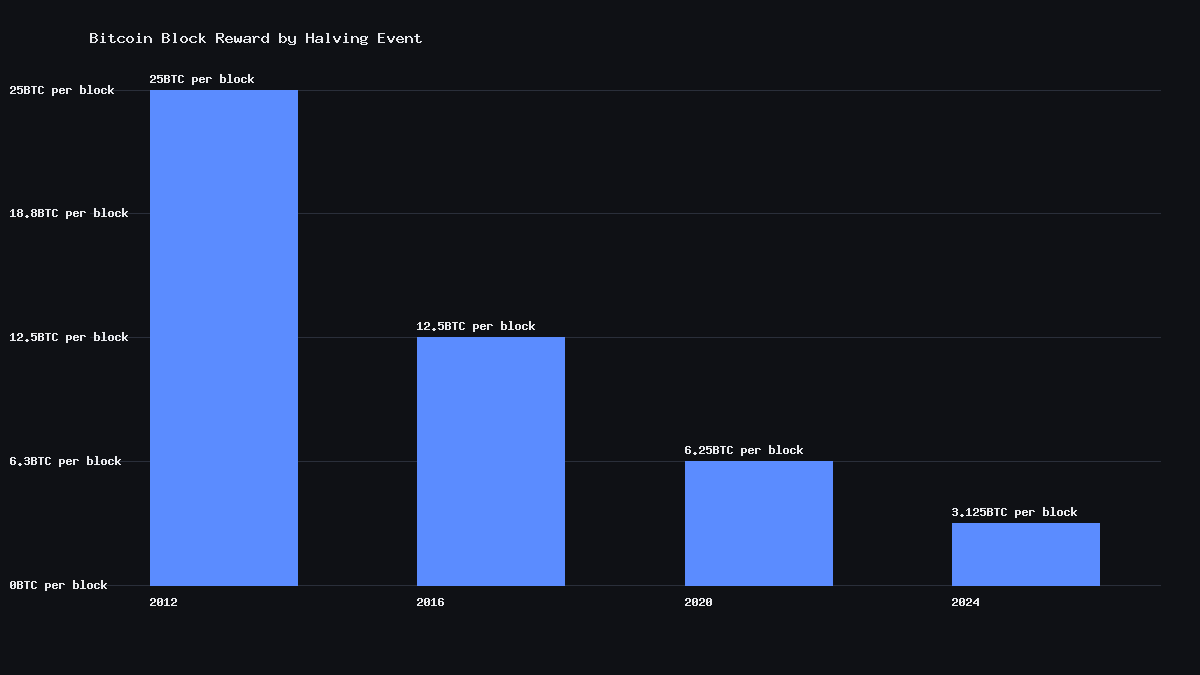
Notice the pattern: the block reward doesn’t fall on a fixed calendar schedule, it falls on a fixed block-count schedule. Faster or slower average block times (which can drift slightly depending on how much mining power is competing for blocks) can nudge the exact halving date a few days earlier or later than a clean four-year mark, which is why the 2024 halving landed in April rather than exactly four years after May 2020.
Why halving matters for price
The argument for why halving should matter to price is a straightforward supply-and-demand story. Miners are the main source of newly created bitcoin entering circulation, and a meaningful share of what they earn gets sold to cover operating costs like electricity and hardware. When the block reward is cut in half overnight, the flow of new coins miners can sell is cut in half too. If buyer demand stays the same or keeps growing while that new supply shrinks, basic economics says the price should feel upward pressure — assuming nothing else changes, which in real markets it always does.
This is sometimes framed using a “stock-to-flow” model — comparing Bitcoin’s existing total supply (the stock) to its rate of new issuance (the flow). Each halving increases that ratio, making Bitcoin structurally scarcer in the same way gold’s slow, steady mining output has helped keep its scarcity ratio high for centuries. Supporters point to this as a reason halving events tend to matter more than they would for an asset with unlimited or flexible issuance. Critics point out that the model has produced price predictions that didn’t hold up, and that treating a supply metric as the dominant price driver ignores demand-side factors — interest rates, risk appetite, regulation, and macro conditions — that have moved crypto prices just as much or more.
It’s also worth being precise about magnitude: even before a halving, newly mined coins are a small fraction of total daily trading volume on major exchanges. The halving’s effect on the marginal supply of coins for sale is real, but it’s not the only — or necessarily the largest — factor moving price on any given day.
What actually happened to price after each halving
Looking at what actually happened historically, rather than what the theory predicts, is more useful — with the caveat that four data points isn’t a large sample, and each cycle unfolded against a very different macro and market backdrop.
| Halving | Approx. price on halving day | Approx. price ~12 months later | Approx. change |
|---|---|---|---|
| November 2012 | ~$12 | ~$1,150 (Nov 2013) | ~+9,500% |
| July 2016 | ~$650 | ~$2,550 (Jul 2017) | ~+290% |
| May 2020 | ~$8,700 | ~$56,700 (May 2021) | ~+550% |
| April 2024 | ~$63,800 | ~$85,000–$95,000 (Apr 2025) | ~+35–45% |
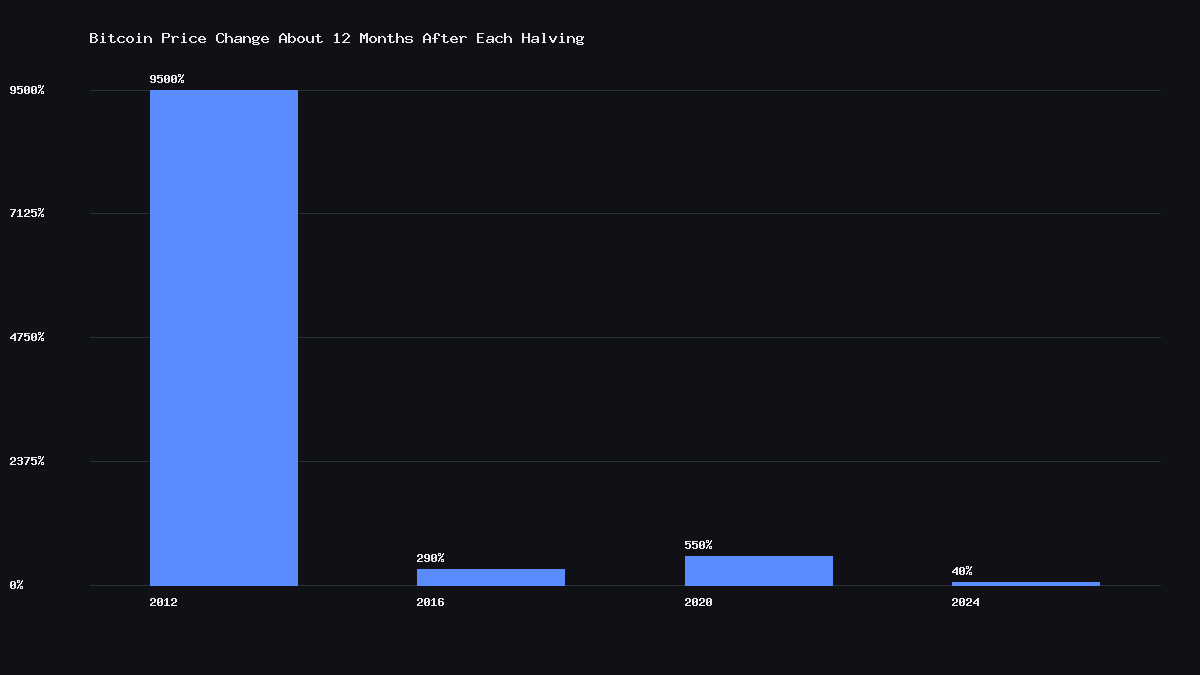
These figures are approximate and rounded, drawn from public market-data trackers, and meant to illustrate the pattern rather than serve as precise price references. Two things stand out. First, every single one of the four halvings so far was followed by a substantially higher price a year later — a perfect track record, but with only four instances to draw on. Second, the size of the move has shrunk with each cycle, which is consistent with a market that’s larger, more liquid, and has more sophisticated participants than it did in 2012, when a relatively small amount of new buying could move the price dramatically. A market capitalization in the hundreds of billions or low trillions of dollars simply cannot move by the same multiples a much smaller market once did.
It’s also worth flagging that the biggest price peaks of the 2016 and 2020 cycles didn’t happen right on the halving date — they showed up roughly 12 to 18 months afterward, in December 2017 and November 2021 respectively. That lag is part of why some analysts describe halvings as setting up a supply backdrop rather than triggering an immediate price reaction.
Halving’s effect on miners
Halving doesn’t just affect holders and traders — it directly cuts miner revenue from block rewards in half overnight, without cutting their electricity bills or hardware costs at all. Miners running older, less efficient equipment, or paying higher electricity rates, can find their operations unprofitable literally overnight once the reward drops. That’s typically followed by some miners shutting down or upgrading hardware, which temporarily reduces the total computing power (hash rate) securing the network until the difficulty adjustment — another built-in mechanism — recalibrates to the new, lower hash rate over the following weeks.
Over time, this has pushed mining to become more institutional and efficiency-driven, since only operations with access to cheap power and modern hardware can stay profitable through repeated reward cuts. Transaction fees, which miners also collect on top of the block reward, become proportionally more important to miner revenue with each halving — a shift the Bitcoin protocol was explicitly designed to lean on more heavily as block rewards continue shrinking toward zero over the coming century.
Mini glossary
| Term | What it means |
|---|---|
| Block reward | The amount of new bitcoin paid to a miner for successfully mining a block |
| Block height | The number of the block in the blockchain’s sequence, counting up from block 0 (the genesis block) |
| Hash rate | The total computing power currently securing the Bitcoin network |
| Difficulty adjustment | An automatic recalibration (roughly every two weeks) that keeps average block times near ten minutes as hash rate rises or falls |
| Stock-to-flow | A model comparing an asset’s existing supply (stock) to its rate of new production (flow) as a scarcity measure |
| Supply cap | The hard-coded maximum of 21 million bitcoin that will ever exist |
Where this shows up on EskiSignal
Halving cycles sit in the background of a lot of EskiSignal’s crypto coverage even when a piece isn’t explicitly about the halving itself. When on-chain and whale-flow pieces track miner wallets selling or accumulating, halving-driven changes in miner economics are often part of that story. When leverage and liquidation cascades get covered, they’re frequently happening against the backdrop of a broader cycle that halving expectations helped set up. And stablecoin and derivatives coverage on this site regularly references the same multi-year cycle framing that halving analysis relies on.
Risks and limits of the halving narrative
It’s worth being direct about the limits of what halving can actually tell you. Four halvings is a very small sample size to draw firm conclusions from, and each cycle happened alongside major macro shifts — near-zero interest rates in 2020–2021, a global pandemic liquidity surge, changing regulatory environments, and shifting institutional adoption — any of which could plausibly explain some or most of the price moves typically credited to the halving alone.
There’s also a well-known problem with widely anticipated events in markets: if enough participants expect a halving to push prices up, some of that expected move can get priced in ahead of time, which is part of why some analysts have argued the halving’s price effect should theoretically get weaker, not stronger, as it becomes more widely understood and anticipated. Past performance following prior halvings is not a guarantee of what happens after any future one, and the shrinking percentage gains across the four cycles so far are consistent with that idea, though far from proof of it.
None of this means the halving is irrelevant — the supply-side mechanics are real and verifiable on the blockchain itself, unlike many other claims made about crypto assets. It means the halving is one input among many, not a standalone price-prediction tool.
What is Bitcoin halving in one sentence?
It’s a hard-coded event, roughly every four years, that cuts the reward miners earn for confirming new blocks exactly in half, slowing the rate at which new bitcoin enters circulation.
When is the next Bitcoin halving?
The fourth halving happened in April 2024, cutting the reward to 3.125 BTC. Based on the roughly four-year, 210,000-block cycle, the fifth halving is expected around 2028, though the exact date depends on actual block times between now and then.
Does Bitcoin halving guarantee the price will go up?
No. It has been followed by higher prices a year later in all four cases so far, but that’s a small sample, and each cycle coincided with different macro and market conditions that arguably drove much of the move. Halving changes supply mechanics; it doesn’t guarantee demand.
What happens when Bitcoin’s block reward eventually reaches zero?
Around the year 2140, the block reward is expected to round down to zero as it keeps halving toward Bitcoin’s 21 million supply cap. At that point, miners are expected to be compensated entirely through transaction fees rather than newly issued coins, which is why fee revenue becoming a larger share of miner income with each halving is considered part of the network’s long-term design, not a flaw.
Sources
- Bitcoin’s public, open-source protocol code and blockchain explorers showing historical block heights, reward amounts, and halving dates
- Aggregated crypto market-data trackers reporting historical daily price data around each halving date
- Academic and industry research on stock-to-flow scarcity models and their critiques
- EskiSignal’s own prior reporting on crypto liquidations, on-chain flows, and derivatives market structure