A company can grow earnings per share without selling a single extra product, hiring a single extra employee, or raising prices at all. All it has to do is buy back its own stock and retire the shares — shrinking the denominator in the EPS math rather than growing the numerator. It’s one of the most common and most misunderstood moves in corporate finance.
This article is for informational and educational purposes only. It is not financial advice, investment advice, or a recommendation to buy, sell, or hold any security, cryptocurrency, or financial product. Always verify data with official sources before making financial decisions.
Quick answer: what is a stock buyback?
Quick answer: A stock buyback (or share repurchase) is when a company uses its own cash to purchase its shares on the open market, then typically retires them, reducing the total number of shares outstanding. With fewer shares outstanding, the same total net income is divided among fewer shares — mechanically raising earnings per share (EPS) even if the company’s actual profit hasn’t grown at all. Buybacks are one of two main ways public companies return cash to shareholders, alongside dividends, and in recent years have become the larger of the two among S&P 500 companies by total dollar volume.
The mechanics: how a buyback moves EPS
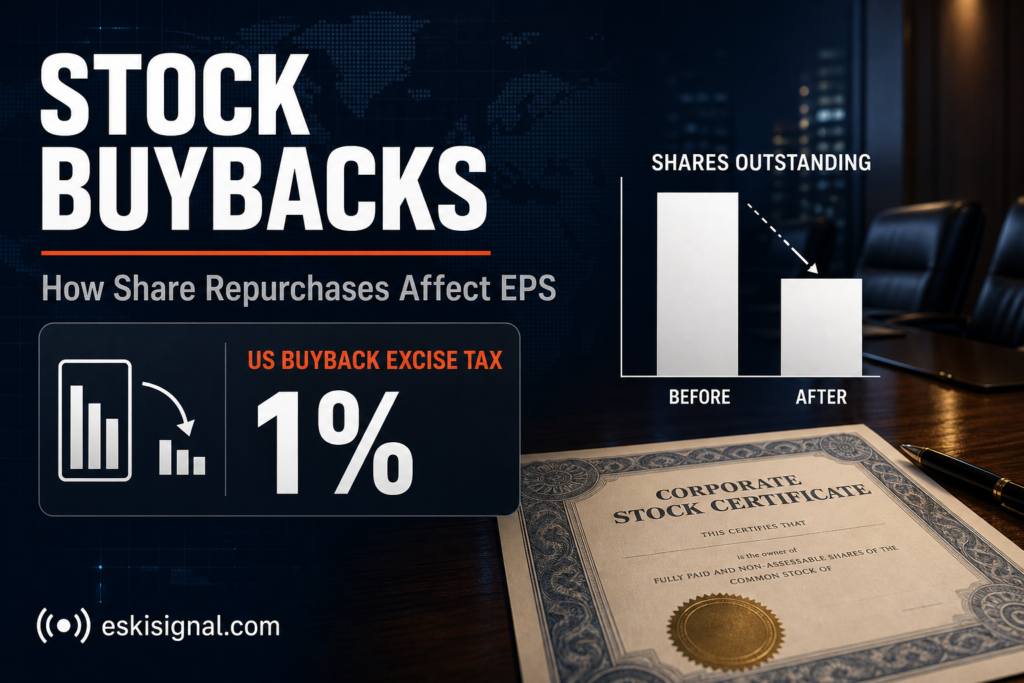
Earnings per share is calculated as net income divided by shares outstanding. A buyback doesn’t need to touch net income at all to move that ratio — it only needs to shrink the share count.
| Before buyback | After buyback (10% of shares retired) | |
|---|---|---|
| Net income | $1,000,000,000 | $1,000,000,000 |
| Shares outstanding | 100,000,000 | 90,000,000 |
| EPS | $10.00 | $11.11 |
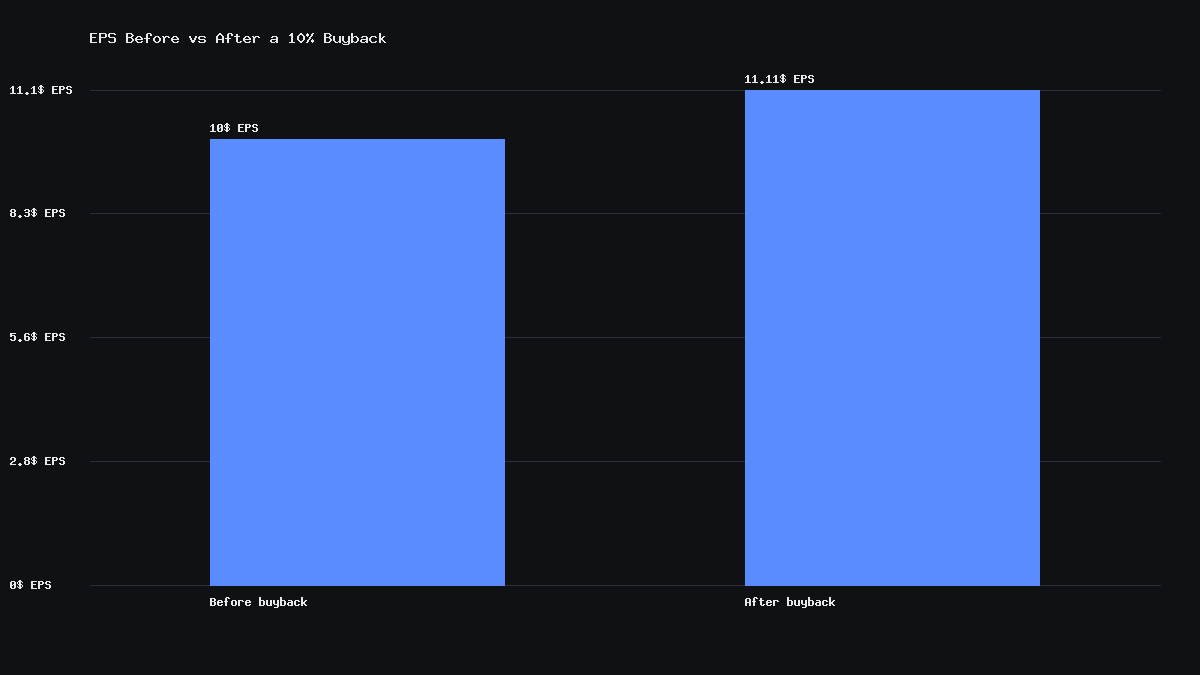
That EPS lift is real from an accounting standpoint, but it’s important to separate it from operational growth. A company can post rising EPS purely from an aggressive buyback program even while revenue and net income are flat or declining — which is why analysts often look at both EPS growth and net income growth side by side, rather than treating a rising EPS figure alone as proof of a healthier underlying business.
Buybacks vs dividends: two ways to return cash
Both buybacks and dividends return excess cash to shareholders, but they work differently and carry different tax and signaling implications.
| Feature | Buyback | Dividend |
|---|---|---|
| How shareholders benefit | Higher EPS and (potentially) share price; no cash received unless shares are sold | Direct cash payment to all shareholders |
| Flexibility | Can be paused or resumed without a public “cut” signal | Cuts are seen as a strong negative signal and are avoided when possible |
| Tax treatment (typical, US) | No tax event unless the shareholder sells shares | Taxable in the year received, in most cases |
| Who benefits | Shareholders who hold; also mechanically raises EPS for options-based executive pay | All shareholders equally per share held |
The flexibility difference matters most in downturns: companies can quietly slow or pause a buyback program with little market reaction, but cutting a long-standing dividend is typically read as a serious red flag and often triggers a sharp stock decline, which is why management teams treat dividend commitments far more cautiously than buyback pace.
The buyback tax and why it exists
Since 2023, US publicly traded companies have faced a 1% excise tax on the net value of stock they buy back, introduced under the Inflation Reduction Act. The tax was designed to narrow the tax-treatment gap between buybacks (historically untaxed at the corporate level) and dividends, and to nudge companies toward using excess cash for reinvestment or wages rather than share repurchases. In practice, at just 1%, it has modestly raised the cost of buybacks without eliminating them as a preferred method of returning cash — buyback volume among large US companies has remained substantial since the tax took effect.

How buybacks are authorized and disclosed
Companies announce buybacks through a board-authorized program with a total dollar or share cap, but authorization doesn’t obligate the company to actually repurchase that full amount — many programs are only partially used, or extended over several years. Actual repurchase activity shows up in quarterly SEC filings (10-Q and 10-K reports), which disclose the number of shares actually bought back during the period, distinct from the headline authorization amount announced in a press release. That distinction matters: a large announced buyback authorization is not the same as cash already spent.
Risks and limits
- A rising EPS driven mainly by buybacks can mask flat or declining underlying net income — check both metrics together.
- Announced buyback authorizations are ceilings, not commitments; actual repurchase activity can fall well short of the headline number.
- Buybacks executed at high share prices can be a less efficient use of cash than buybacks made when shares are cheaper, though companies rarely disclose this trade-off explicitly.
- This is educational content describing buyback mechanics — it is not a recommendation regarding any company’s capital allocation decisions.
Mini glossary
| Term | Plain-English meaning |
|---|---|
| Buyback (share repurchase) | A company purchasing its own shares on the open market |
| Share retirement | Removing repurchased shares from the total shares outstanding |
| EPS (earnings per share) | Net income divided by shares outstanding |
| Buyback authorization | A board-approved ceiling on how much stock a company may repurchase, not a spending commitment |
Do stock buybacks always increase the share price?
Not automatically. Buybacks mechanically raise EPS by reducing share count, which can support a higher valuation if the market maintains the same price-to-earnings multiple, but share price also depends on broader market conditions, growth expectations, and the multiple investors are willing to pay — none of which a buyback directly controls.
Are stock buybacks taxed?
Since 2023, US public companies pay a 1% excise tax on the net value of shares they repurchase, under the Inflation Reduction Act. Shareholders themselves generally don’t owe tax on a buyback unless they choose to sell their shares.
What’s the difference between a buyback authorization and an actual repurchase?
A buyback authorization is a board-approved ceiling on how much stock a company may repurchase, often spread over multiple years. It’s not a spending commitment — actual repurchase activity, disclosed in quarterly SEC filings, can be far smaller than the announced authorization.
Sources
- SEC rules on share repurchase disclosure (Rule 10b-18 and quarterly filing requirements).
- US Inflation Reduction Act of 2022, stock buyback excise tax provisions (effective 2023).
- Public data on S&P 500 aggregate buyback and dividend spending.