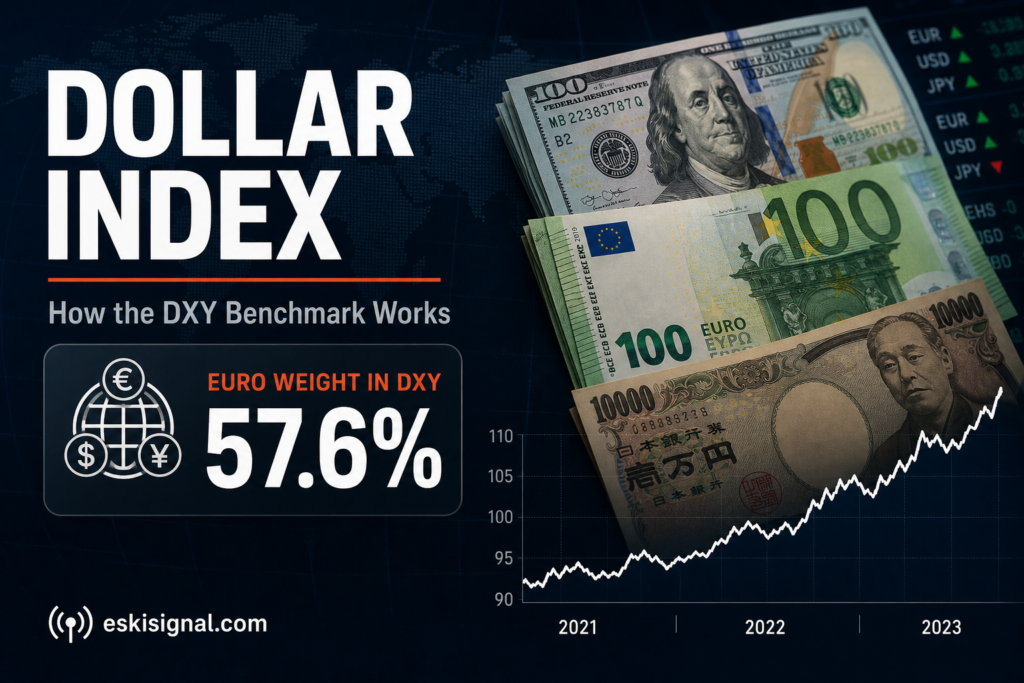
Every time a Fed official hints at a rate move, a single number quietly does most of the reacting before stocks or bonds even open: the US Dollar Index. It doesn’t track the dollar against every currency on Earth — it tracks the dollar against six, and one of those six carries more weight than the other five combined. Understanding that lopsided design is the difference between reading the DXY correctly and misreading it every time the euro has a bad day.
This article is for informational and educational purposes only. It is not financial advice, investment advice, or a recommendation to buy, sell, or hold any security, cryptocurrency, or financial product. Always verify data with official sources before making financial decisions.
Quick answer: what is the US Dollar Index (DXY)?
Quick answer: The US Dollar Index (DXY) is a weighted geometric average of the US dollar’s exchange rate against six major foreign currencies: the euro, Japanese yen, British pound, Canadian dollar, Swedish krona, and Swiss franc. The euro alone makes up 57.6% of the index, which means the DXY often moves more on eurozone news than on anything happening in the US. A rising DXY means the dollar is strengthening against that basket; a falling DXY means it’s weakening. Traders watch it as a proxy for global dollar demand, risk sentiment, and the relative direction of US versus foreign interest rates.
How the DXY is actually built
The index was created by the ICE (formerly the New York Board of Trade) in 1973, when the Bretton Woods system of fixed exchange rates collapsed and the dollar started floating freely against other currencies. The base value was set at 100.00 at that starting point, so a DXY reading above 100 means the dollar has strengthened against the original 1973 basket on average, and a reading below 100 means it has weakened. The six-currency weighting has been adjusted only once since then, in 1999, to fold in the newly created euro.
The weights are not equal, and that’s the detail most people miss:
| Currency | Weight in DXY |
|---|---|
| Euro (EUR) | 57.6% |
| Japanese yen (JPY) | 13.6% |
| British pound (GBP) | 11.9% |
| Canadian dollar (CAD) | 9.1% |
| Swedish krona (SEK) | 4.2% |
| Swiss franc (CHF) | 3.6% |
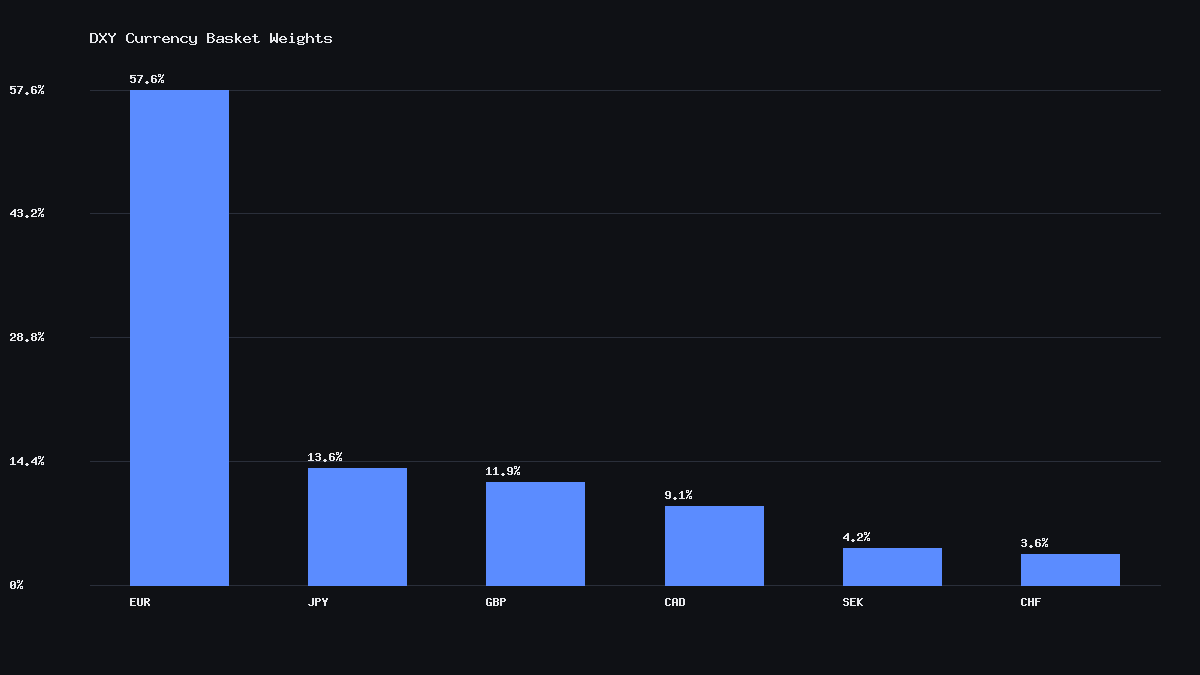
Because the euro carries more weight than the other five currencies combined, the DXY behaves less like a true “dollar vs the world” gauge and more like a dollar-vs-euro gauge with a few adjustments layered on top. A move in the yen or the Swiss franc barely nudges the index; a move in the euro can swing it meaningfully on its own.
Why the DXY moves markets beyond currency trading
The DXY is watched well outside the foreign-exchange world because a stronger or weaker dollar ripples into commodities, corporate earnings, and emerging-market debt. Since oil, gold, and most commodities are priced in dollars globally, a rising DXY tends to make those commodities more expensive for buyers holding other currencies, which typically pressures commodity prices lower — and the reverse holds when the dollar weakens. For large US multinationals, a stronger dollar makes overseas revenue worth less once converted back home, which is why companies with heavy international sales flag DXY moves directly in earnings calls.
The index also acts as a rough proxy for interest-rate differentials. When the Federal Reserve holds rates higher than other major central banks, dollar-denominated assets pay more to hold, which tends to draw in foreign capital and push the DXY higher. When the Fed cuts or signals cuts while other central banks hold steady, that differential narrows and the dollar often weakens. This is why the DXY frequently spikes or drops in the minutes around a Fed statement, even before equity markets fully react.
DXY vs a true trade-weighted dollar index
The DXY is not the only dollar index, and it’s worth knowing the difference so headlines don’t get conflated. The Federal Reserve publishes its own broad trade-weighted dollar index that includes many more currencies — including the Chinese yuan, Mexican peso, and South Korean won — weighted by actual US trade volume rather than a fixed 1973-era basket.
| Feature | ICE US Dollar Index (DXY) | Federal Reserve Broad Dollar Index |
|---|---|---|
| Currencies included | 6 (EUR, JPY, GBP, CAD, SEK, CHF) | 26+ currencies including CNY, MXN, KRW |
| Weighting basis | Fixed 1973 trade weights, updated once in 1999 | Updated periodically based on actual trade flows |
| China exposure | None | Significant — China is a top US trading partner |
| Where it’s quoted | Tradable futures/ETFs, financial news tickers | Published periodically by the Federal Reserve |
The DXY is more widely quoted because it’s tradable — via futures on ICE and ETFs that track it — while the Fed’s broad index exists mainly as an economic research and policy tool. That tradability is exactly why financial media leans on the DXY: it updates in real time and has decades of continuous futures history, even though it leaves out currencies tied to some of the largest US trading relationships.
A real-world pattern: the 2022 dollar surge
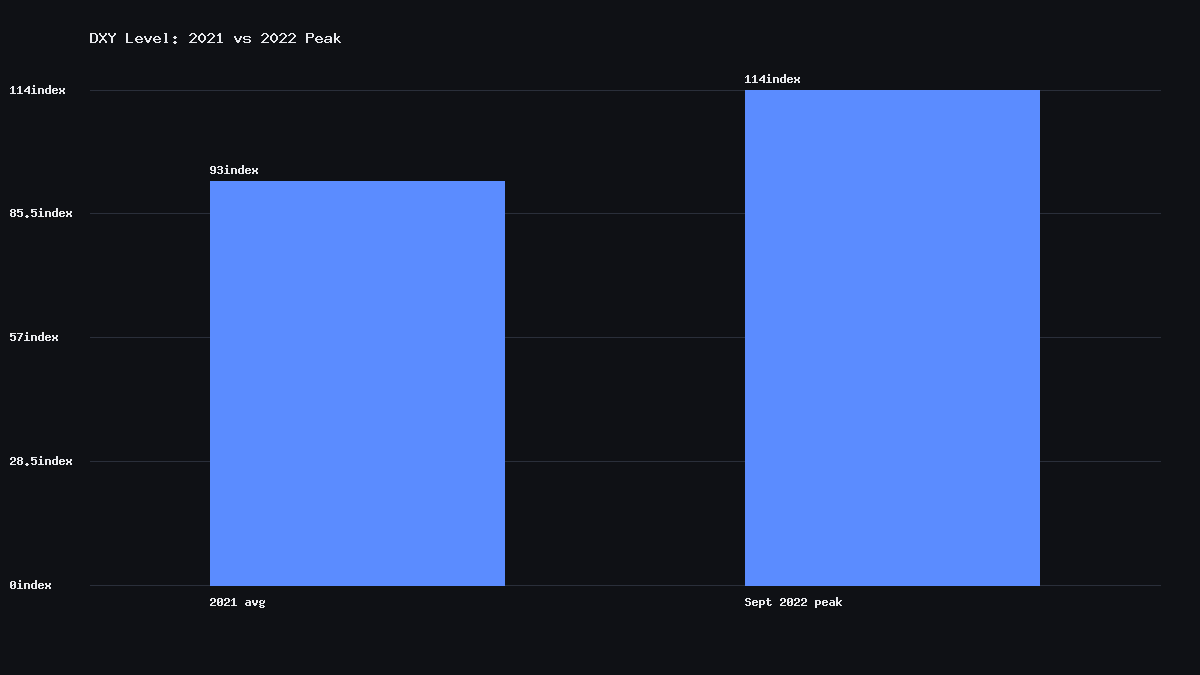
One of the clearest recent illustrations of DXY mechanics came in 2022, when the Federal Reserve raised rates aggressively while the European Central Bank and Bank of Japan moved far more slowly. The widening rate gap pushed the DXY to roughly 114 in September 2022 — its highest level in two decades — with the yen and euro among the hardest-hit components. The euro briefly traded below parity with the dollar (below 1.00) for the first time in 20 years, illustrating just how much a single component can drag the whole index when the rate differential moves sharply.
Risks and limits of reading the DXY
- The DXY says nothing directly about the dollar’s strength against non-basket currencies like the Chinese yuan, Mexican peso, or Indian rupee.
- Because the euro dominates the weighting, DXY moves can reflect eurozone-specific news (ECB policy, European political events) as much as anything happening in the US.
- A rising or falling DXY does not by itself predict stock market direction — the relationship with equities shifts depending on what’s driving the dollar move.
- This is educational content describing how the index is constructed — it is not a trading signal or a prediction of future currency moves.
Mini glossary
| Term | Plain-English meaning |
|---|---|
| DXY | The ICE US Dollar Index, tracking the dollar against six major currencies |
| Trade-weighted index | An index where each currency’s influence reflects actual trade volume with the US |
| Rate differential | The gap between US interest rates and another country’s interest rates |
| Parity | When one currency equals exactly 1.00 units of another, as the euro did against the dollar in 2022 |
What does it mean when the DXY is rising?
A rising DXY means the dollar is strengthening against the six-currency basket, most heavily influenced by the euro. This often coincides with the Fed holding rates higher than other major central banks, higher demand for dollar-denominated safe assets, or weakness in the euro or yen specifically.
Why doesn’t the DXY include the Chinese yuan?
The DXY’s basket was fixed in 1973 and only updated once, in 1999, to add the euro. China’s currency wasn’t a major factor in global trade at that time in the way it is today, so it was never added. The Federal Reserve’s separate broad dollar index does include the yuan.
How is the DXY calculated?
The DXY is a weighted geometric mean of the dollar’s exchange rate against the euro, yen, pound, Canadian dollar, krona, and franc, using fixed weights of 57.6%, 13.6%, 11.9%, 9.1%, 4.2%, and 3.6% respectively, indexed to a base value of 100 set in March 1973.
Can you trade the DXY directly?
Yes — the DXY has tradable futures contracts on ICE, and several ETFs are designed to track its movement, giving traders exposure to broad dollar strength or weakness without trading six individual currency pairs.
Want to see how a weaker or stronger dollar translates into real conversions? Use our Currency Converter for live exchange rates across 30+ currencies.
Sources
- ICE Data Indices, US Dollar Index (DXY) methodology and component weights.
- Federal Reserve Board, Trade-Weighted US Dollar Index documentation.
- Public market data and reporting on 2022 dollar and euro-parity moves.