On March 16, 2020, the S&P 500 opened so far below the previous day’s close that exchanges froze trading nationwide within seconds of the bell — not because of a technical glitch, but because a rule automatically shut the market down. That rule is the market-wide circuit breaker, and it’s one of the few mechanisms designed to do something markets otherwise never do on their own: stop.
This article is for informational and educational purposes only. It is not financial advice, investment advice, or a recommendation to buy, sell, or hold any security, cryptocurrency, or financial product. Always verify data with official sources before making financial decisions.
Quick answer: what is a circuit breaker in stock trading?
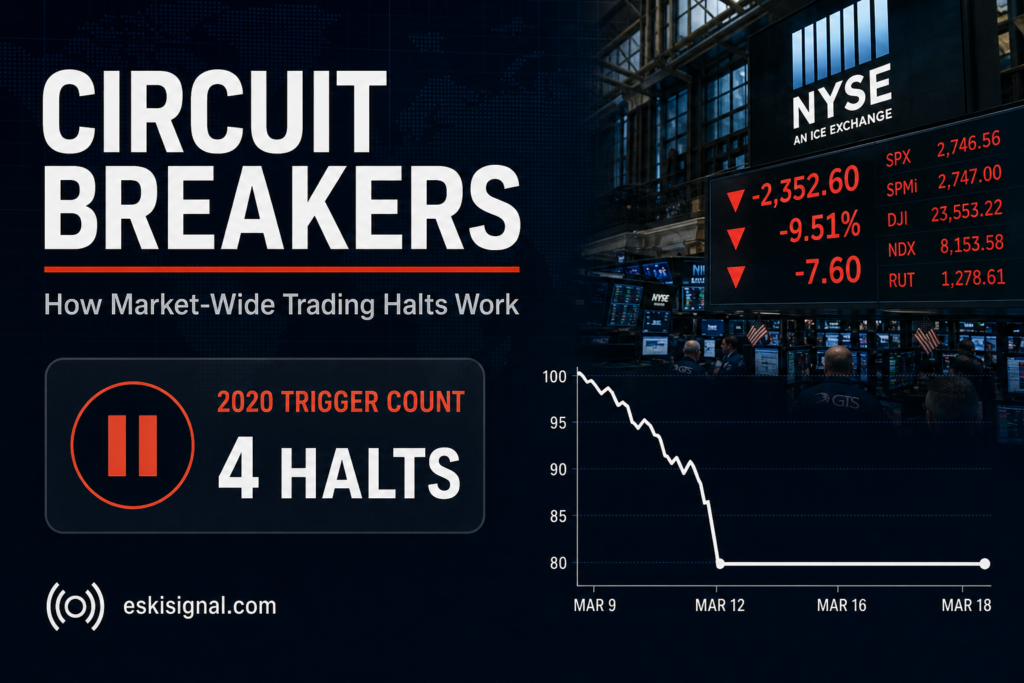
Quick answer: A market-wide circuit breaker is an automatic, exchange-enforced trading halt triggered when the S&P 500 falls too far, too fast in a single session. There are three thresholds — Level 1 (7%), Level 2 (13%), and Level 3 (20%) — measured against the prior day’s closing price. Level 1 and Level 2 halts pause trading across all US stock exchanges for 15 minutes; a Level 3 breach shuts the market down for the rest of the day. The rule exists to give traders and algorithms a forced pause to reassess, rather than letting a freefall feed on itself. It was triggered four times in March 2020, all at Level 1 — the first time it had fired since the current rules took effect in 2013.
How market-wide circuit breakers actually work
Circuit breakers are governed by exchange rules — Rule 80B on the NYSE, mirrored across Nasdaq and other US exchanges — that all reference the same benchmark: the percentage decline in the S&P 500 index versus its closing level from the previous trading day. When the index crosses one of three thresholds, every US stock exchange halts trading simultaneously, regardless of where a stock is listed. This is different from a single-stock halt; a market-wide circuit breaker stops trading in effectively the entire US equity market at once.
The three levels aren’t interchangeable — each carries a different consequence, and timing matters as much as the size of the drop:
| Level | S&P 500 decline threshold | Halt duration | Can it trigger late in the day? |
|---|---|---|---|
| Level 1 | 7% | 15 minutes | Not after 3:25 p.m. ET — trading continues instead |
| Level 2 | 13% | 15 minutes | Not after 3:25 p.m. ET — trading continues instead |
| Level 3 | 20% | Rest of the trading day | Yes, at any time — market closes for the day |
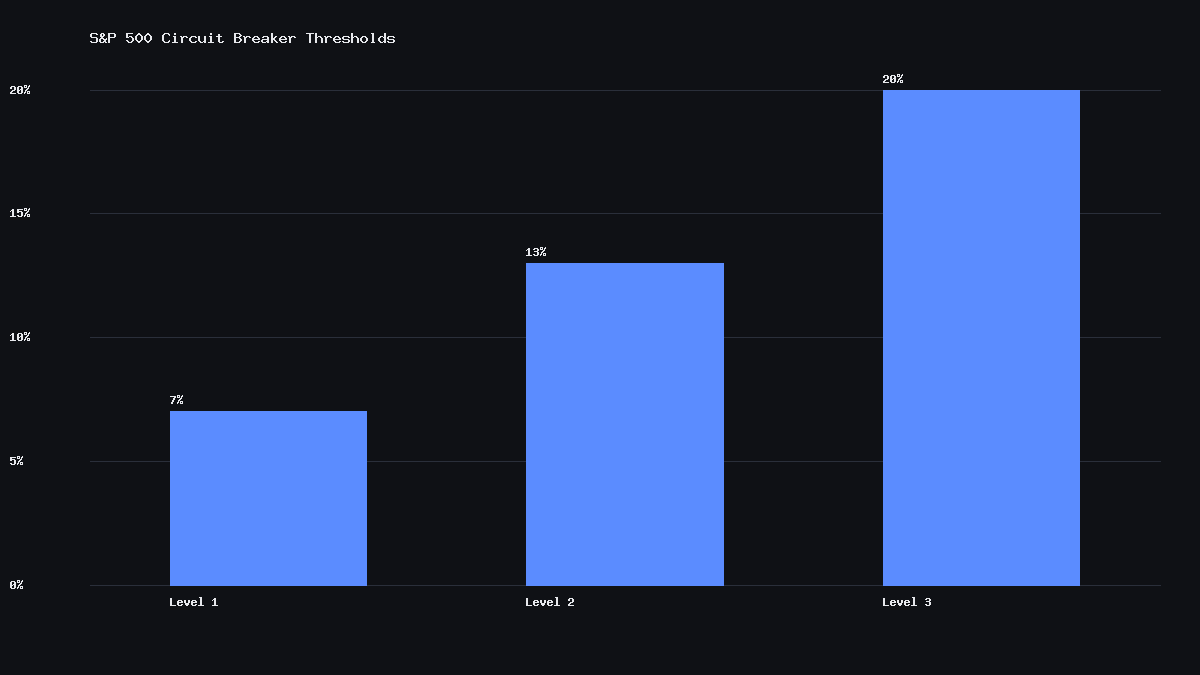
Two design details matter here. First, Level 1 and Level 2 halts can each only happen once per day — if the market claws back and then falls through the next threshold, that triggers the next level’s halt, but the market doesn’t re-halt at a level it already crossed. Second, the “not after 3:25 p.m.” rule for Levels 1 and 2 exists so a late-day 15-minute halt doesn’t simply eat the last few minutes of the trading session; regulators decided it was better to let trading continue than freeze the close. Level 3 has no such carve-out — a 20% decline closes the market for the day no matter when it happens.
A real-world example: March 2020
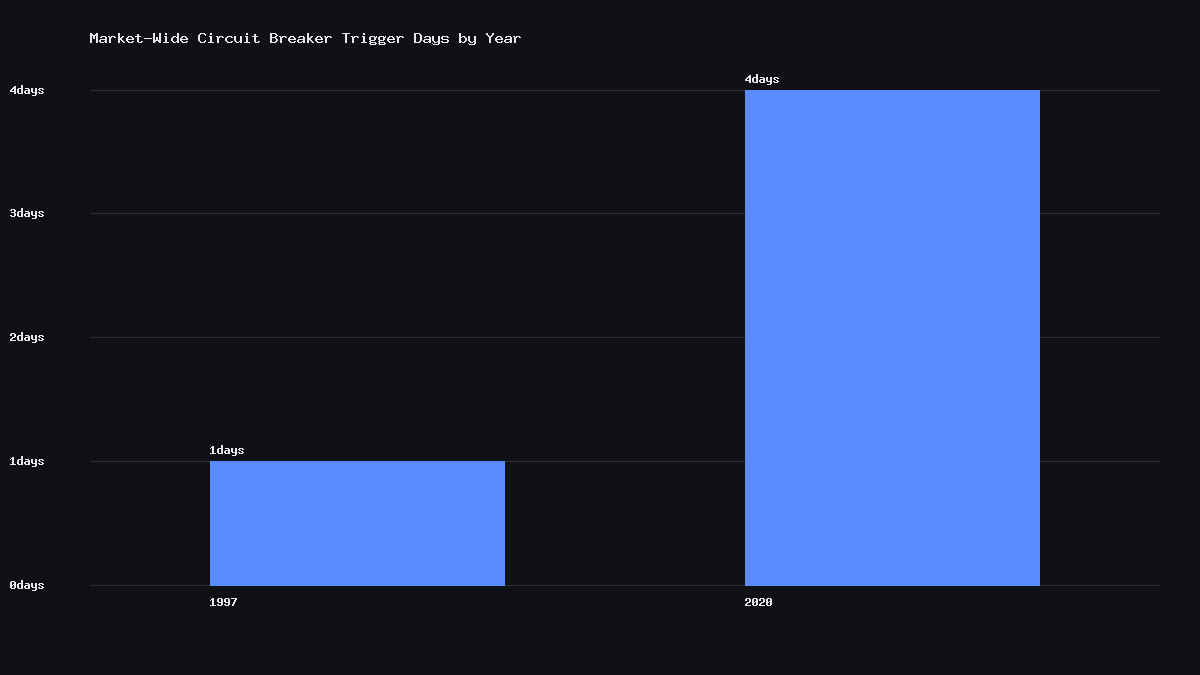
The current rules, adopted by the SEC in 2012 and effective from April 2013, went eight years without being used at all. Then, in a single month, they triggered four times:
- March 9, 2020 — Level 1 triggered at the open as oil-price shocks and early COVID-19 fears drove a sharp opening drop.
- March 12, 2020 — Level 1 triggered again as the World Health Organization’s pandemic declaration and escalating lockdowns hit sentiment.
- March 16, 2020 — Level 1 triggered at the open on what became one of the S&P 500’s worst single-day point drops on record.
- March 18, 2020 — Level 1 triggered a fourth time as volatility remained extreme through the month.
All four 2020 halts stopped at Level 1 — the S&P 500 never fell far enough in a single session to reach the 13% or 20% thresholds. Before that, the only prior trigger of a market-wide circuit breaker was on October 27, 1997, under an older, now-defunct points-based version of the rule — meaning the current 7/13/20% system had never fired even once in its first eight years of existence before March 2020 tested it four times in nine trading days.
Market-wide circuit breakers vs single-stock trading halts
It’s easy to conflate the market-wide circuit breaker with the halts you see on individual stocks, but they’re separate systems with separate purposes.
| Feature | Market-wide circuit breaker | Single-stock halt (Limit Up-Limit Down) |
|---|---|---|
| Trigger | S&P 500 index-level decline | One stock’s price moving outside a set price band |
| Scope | Halts all US exchanges at once | Halts trading in that one security only |
| Common cause | Broad macro shock or panic selling | Company-specific news, earnings, or a data/liquidity glitch |
| Frequency | Extremely rare (5 trigger days in market history) | Routine — happens on individual names most trading days |
Single-stock halts (often called Limit Up-Limit Down, or LULD) are common and mostly unremarkable — a stock’s news catches up with its price and trading resumes within minutes. A market-wide circuit breaker is the rare, blunt-force version: a signal that the panic is systemic, not confined to one name or sector.
Why circuit breakers exist
The modern circuit breaker system traces back to Black Monday, October 19, 1987, when the Dow Jones Industrial Average fell over 20% in a single session with no mechanism to pause trading. Regulators introduced the first circuit breakers the following year. The rules have been revised twice since — after the 1997 trigger exposed problems with a points-based threshold in a rising market, and again after the May 2010 “Flash Crash,” which led to the current percentage-based, S&P 500-referenced system used today. The underlying goal hasn’t changed: give human decision-making, risk checks, and algorithmic trading systems a mandatory pause before a decline can spiral through forced selling and thin liquidity.
Risks and limits
- A circuit breaker pauses trading; it does not reverse the decline or guarantee prices stabilize once trading resumes.
- The thresholds apply to the S&P 500 only — other indexes or individual stocks can still move sharply without triggering a market-wide halt.
- Because Level 1 and 2 halts don’t apply after 3:25 p.m. ET, a late-session plunge of 7-13% would not pause trading at all.
- This is educational content describing how the rule works — it is not a signal, prediction, or trading strategy.
Mini glossary
| Term | Plain-English meaning |
|---|---|
| Circuit breaker | An automatic rule that halts trading after a large, fast decline |
| Rule 80B | The NYSE rule (mirrored across exchanges) that defines the market-wide circuit breaker |
| Limit Up-Limit Down (LULD) | The separate system that halts trading in one stock when its price moves outside a set band |
| Reference price | The prior trading day’s closing level used to calculate the percentage decline |
What percentage drop triggers a stock market circuit breaker?
A 7% decline in the S&P 500 from the prior close triggers Level 1, a 13% decline triggers Level 2, and a 20% decline triggers Level 3. All three are measured against the S&P 500 specifically, not the Dow or Nasdaq.
How long does a circuit-breaker halt last?
Level 1 and Level 2 halts last 15 minutes, after which trading resumes. A Level 3 halt stops trading for the remainder of that trading day — the market does not reopen until the next session.
What happens if the market falls 20% in one day?
A 20% single-day decline in the S&P 500 triggers Level 3, which closes US stock exchanges for the rest of the day regardless of what time it happens. Trading resumes at the next scheduled session.
When was the last time a market-wide circuit breaker was triggered?
The most recent trigger was March 18, 2020, the fourth Level 1 halt that month. Before March 2020, the current percentage-based system had never been triggered since it took effect in 2013.
Sources
- NYSE and SEC rule filings on market-wide circuit breakers (Rule 80B) and Limit Up-Limit Down.
- SEC historical documentation on circuit-breaker rule changes following the 1987 and 2010 market events.
- Public market data and reporting on the March 2020 circuit-breaker trigger days.