Estimate what a Series I savings bond will be worth, and compare buying before the next rate reset with buying after it. The current rates come from TreasuryDirect. The inflation part of the next rate is calculated from the official CPI data using Treasury’s own method, so it is known before Treasury announces it — only the fixed rate is a guess.
| Scenario | Value at redemption | Interest earned | Annualized |
|---|
Rate schedule
| Months held | Period starts | Composite rate | Value at end of period |
|---|
How I bond interest works
An I bond earns a composite rate built from two parts. The fixed rate is set when you buy and never changes. The semiannual inflation rate is reset every May 1 and November 1 and applies to every I bond in existence. TreasuryDirect combines them as: composite = fixed + (2 × semiannual inflation) + (fixed × semiannual inflation). The composite rate cannot fall below zero.
Each bond’s rate changes every six months from its own issue month, not on May 1 or November 1. A bond bought in October earns the current composite for its first six months and switches to the November inflation rate the following April. Interest is added monthly and compounds every six months.
How the next inflation component is calculated
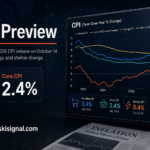
The semiannual inflation rate is the percentage change in the non-seasonally-adjusted CPI-U over six months. The November rate uses the change from March to September; the May rate uses September to March. Because those CPI figures are published before the reset, the inflation half of the new rate can be computed in advance. As a check, CPI-U for March 2026 divided by September 2025 gives 1.67%, exactly the rate TreasuryDirect set on May 1, 2026.
Until the September CPI is released (on October 14 in 2026), the figure on this page is a projection from the latest month available and is labelled as such. After that it is exact. The fixed rate has no published formula and is not known until Treasury announces it.
Rules worth knowing before you buy
You cannot cash an I bond in the first 12 months. If you cash it before five years, you lose the last three months of interest — the calculator deducts that automatically for holding periods under five years. Electronic I bonds are bought through TreasuryDirect, which sets an annual purchase limit per person; check TreasuryDirect for the current limit and rules.
Recent fixed rates
Fixed rates set by Treasury: May 1, 2026: 0.90%. November 1, 2025: 0.90%. May 1, 2025: 1.10%. November 1, 2024: 1.20%. May 1, 2024: 1.30%. November 1, 2023: 1.30%. Source: TreasuryDirect.
Related EskiSignal guides
- CPI Release Dates 2026: Inflation Report Schedule, Times and Market Impact
- PCE vs CPI: The Two U.S. Inflation Gauges Explained
- Term Premium: Why Long Yields Can Rise While the Fed Sits Still
This tool is provided for informational and educational purposes only. It is not financial, investment or tax advice. Always verify figures with the official source before making financial decisions.