
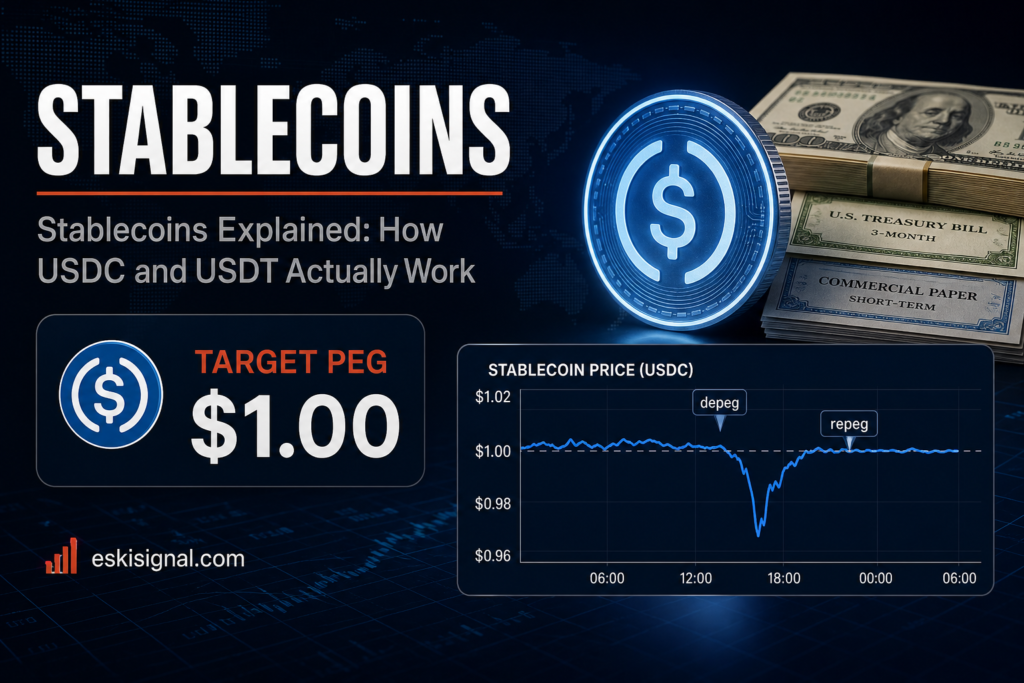
Every crypto trade has to start and end somewhere, and increasingly that somewhere is a stablecoin. Not bitcoin, not a bank account — a token designed to do the one thing most of crypto refuses to do, which is sit still at a dollar. That single idea, boring as it sounds, moves more daily volume than almost anything else in digital assets.
This article is for informational and educational purposes only. It is not financial advice, investment advice, or a recommendation to buy, sell, or hold any security, cryptocurrency, or financial product. Always verify data with official sources before making financial decisions.
Short answer — what a stablecoin is
A stablecoin is a crypto token built to hold a steady price, almost always $1, instead of floating freely like bitcoin or ether. The two biggest by far are USDT (Tether) and USDC (Circle), and together they underpin a huge share of daily trading volume across crypto exchanges.
The mechanism is simple in concept: someone holds real-world assets — cash, short-term government debt, that sort of thing — off-chain, and issues a matching number of tokens on-chain that represent a claim on those assets. One token is supposed to always be redeemable for one dollar. Whether that promise holds up in practice depends on what’s actually backing it and how quickly people can get their money out.
The main types (fiat-backed, crypto-backed, algorithmic)
Not all stablecoins are built the same way, and the differences matter more than most people assume when they’re just clicking “buy” on an exchange. Broadly there are three design families, each with a different answer to the question “what actually stands behind this token?”
| Type | How it’s backed | Examples | Main risk |
|---|---|---|---|
| Fiat-backed | Cash and cash-equivalent reserves held off-chain by a company | USDT, USDC | Reserve quality, issuer trust, redemption access |
| Crypto-backed | Over-collateralized with volatile crypto assets, managed on-chain | DAI-style tokens | Collateral value crashing faster than it can be liquidated |
| Algorithmic | Code and incentive mechanisms, little or no hard collateral | Mostly defunct or niche designs | Death spiral if confidence breaks — historically the least durable model |
Fiat-backed tokens dominate trading volume, which is why this article focuses on how that model works. Crypto-backed designs solve the “who do you trust” problem by using transparent on-chain collateral, but they trade that for exposure to crypto’s own volatility. Algorithmic models have mostly fallen out of favor after a string of high-profile failures showed how fast confidence can evaporate when there’s no hard asset underneath.
How a fiat-backed stablecoin stays at $1
The peg isn’t magic, and it isn’t enforced by a trading algorithm either. It rests on two things working together: reserves and arbitrage.
First, the issuer — Circle for USDC, Tether for USDT — holds reserves meant to match the number of tokens in circulation, typically a mix of cash, short-term Treasury bills, and repo agreements. Second, large institutional clients (“authorized” participants, roughly speaking) can mint new tokens by sending the issuer dollars, or redeem tokens for dollars directly. That direct redemption channel is usually gated behind minimum sizes and verification, so it’s not something an average retail holder does routinely.
That redemption path is what keeps the price near $1 on the open market. If a stablecoin ever traded at, say, $0.98 on an exchange, a trader with redemption access could buy it cheap and redeem it for a full dollar from the issuer, pocketing the difference. That buying pressure pushes the price back up. The reverse works too — if it traded above $1, someone could mint new tokens at $1 and sell them at the higher price. This arbitrage loop is what does the actual work of holding the peg day to day, and it only functions as long as people trust that redemption will actually happen.
Why stablecoins matter for crypto markets
Stablecoins aren’t a side product in crypto — they’re closer to plumbing. Most trading pairs on most exchanges are priced against a stablecoin rather than a real dollar, because moving actual fiat on and off exchanges is slow and often expensive, while moving USDT or USDC is near-instant and works around the clock, weekends included.
They also function as a parking spot. Traders who sell bitcoin during a selloff often don’t cash out to a bank account — they rotate into stablecoins, staying inside the crypto ecosystem while sitting out volatility. That balance sitting in stablecoins on exchanges is sometimes called “dry powder,” a rough proxy for money that could flow back into risk assets if sentiment turns. It’s an imperfect signal, since stablecoins get used for plenty of things besides waiting to buy a dip, but it’s watched closely all the same.
The reserve and “depeg” question
The core vulnerability of a fiat-backed stablecoin is straightforward: the peg only holds as long as people believe redemption works, and belief can move a lot faster than the underlying reserves. In the U.S., the GENIUS Act — passed in 2025 — set new federal rules around reserve composition, audits, and disclosure for payment stablecoin issuers. EskiSignal has already covered that law in depth in The GENIUS Act Explained: New U.S. Stablecoin Rules for USDC and USDT, so this piece won’t re-tread the legal side — worth a read if you want the regulatory detail.
What’s useful here is understanding what a depeg event generically looks like, without pinning it to any specific incident. It usually starts with doubt — a rumor about reserve quality, a delayed audit, a bank that holds part of the reserves running into trouble, or just a broader panic where people want to convert everything to cash at once. If redemptions can’t keep pace with demand, or if the market simply doesn’t believe they can, the token can trade below $1 on exchanges even while the issuer insists reserves are fine. Prices sometimes recover within hours once redemption resumes normally; other times the damage to trust lingers much longer. The size of the wobble tends to depend on how transparent and liquid the reserves actually are, not just how the issuer describes them.
Stablecoin flows as an on-chain signal
Because stablecoins sit at the center of so much crypto activity, their movements are one of the things on-chain analysts watch alongside exchange inflows and outflows of bitcoin or ether. A large USDT or USDC mint showing up on-chain doesn’t guarantee new buying is coming, but it’s often read as a sign that an exchange or market maker is stocking up on dollar liquidity. Redemptions and burns can point the other way — capital leaving the ecosystem, or at least stepping back from active trading.
Rising stablecoin balances sitting on exchange wallets get lumped into the same “dry powder” conversation mentioned above, and they’re often discussed in the same breath as whale wallet activity and exchange netflows. None of these signals work well in isolation — a stablecoin mint can just as easily be routine treasury management as the front end of a buying wave. For a fuller walkthrough of how analysts read exchange balances, netflows, and wallet-level data together, see Whale Watching and Exchange Flows: What On-Chain Data Really Tells You.
Where this shows up on EskiSignal
Stablecoin dynamics tend to surface in coverage of sudden crypto moves — a bitcoin selloff that coincides with heavy stablecoin minting, or a rally that lines up with exchange balances dropping. If you’re trying to make sense of a specific day’s price action rather than the mechanics behind it, that’s usually a separate but related question.
Mini glossary
| Term | Plain-English meaning |
|---|---|
| Peg | The target price a stablecoin is designed to hold, almost always $1 |
| Reserve | The cash and cash-like assets an issuer holds to back tokens in circulation |
| Redemption | Exchanging a stablecoin directly with the issuer for the underlying dollar |
| Mint | Creating new stablecoin tokens, usually by depositing dollars with the issuer |
| Depeg | When a stablecoin trades meaningfully away from its target price |
| Attestation | A periodic report, often from an accounting firm, on what an issuer’s reserves hold |
| Dry powder | Stablecoin balances sitting idle that could potentially be used to buy other assets |
Risks and limits
A stablecoin is only as strong as three things: the quality of its reserves, the reliability of its redemption process, and the trust the market places in both. Cash and short-term Treasuries are relatively easy to verify and liquidate quickly. Anything murkier — longer-dated debt, corporate paper, assets held at a single counterparty — adds a layer of risk that isn’t always visible from the outside.
There’s also concentration risk: a handful of issuers underpin an enormous share of crypto trading, so problems at one of them can ripple across exchanges, lending platforms, and trading pairs that never touch that issuer directly. And regulatory frameworks like the GENIUS Act, while aimed at tightening reserve and disclosure standards, don’t eliminate the underlying dependency on trust — they just try to make that trust easier to verify. None of this means fiat-backed stablecoins are fragile by default; it means the safety of any given one is a function of specific, checkable facts rather than the brand name printed on the token.
What is a stablecoin?
It’s a crypto token designed to hold a steady value, usually $1, instead of floating like bitcoin or ether. Most of the largest ones do this by holding real-world cash and cash-equivalent reserves against the tokens they’ve issued.
Are stablecoins safe?
They’re generally less volatile than other crypto assets, but “safe” depends entirely on reserve quality, issuer transparency, and redemption reliability. They are not insured deposits and can, in stressed conditions, trade away from their target price.
What’s the difference between USDC and USDT?
Both are fiat-backed dollar stablecoins, but they’re issued by different companies — Circle for USDC and Tether for USDT — with different reserve compositions, disclosure practices, and audit histories. Checking each issuer’s own attestations is the only reliable way to compare them at a given point in time.
What is a depeg?
A depeg is when a stablecoin’s market price drifts meaningfully away from its $1 target, usually because redemption doubts or a liquidity crunch outpace the arbitrage mechanism that normally holds the price in place. Depegs can be brief and self-correcting or can reflect a deeper problem with the reserves themselves.
Sources
- Issuer transparency pages and reserve attestation reports (e.g., Circle and Tether public disclosures)
- U.S. federal guidance and legislative text related to payment stablecoin regulation
- On-chain data and block explorer analytics covering stablecoin supply and transfers
- Reporting from established financial and crypto-focused news outlets