Last updated: June 17, 2026, 11:00 AM ET
Topic: exchange-traded funds (educational explainer).
This article is for informational and educational purposes only. It is not financial advice, investment advice, or a recommendation to buy, sell, or hold any security, cryptocurrency, or financial product. Always verify data with official sources before making financial decisions.
Short answer: what is an ETF?
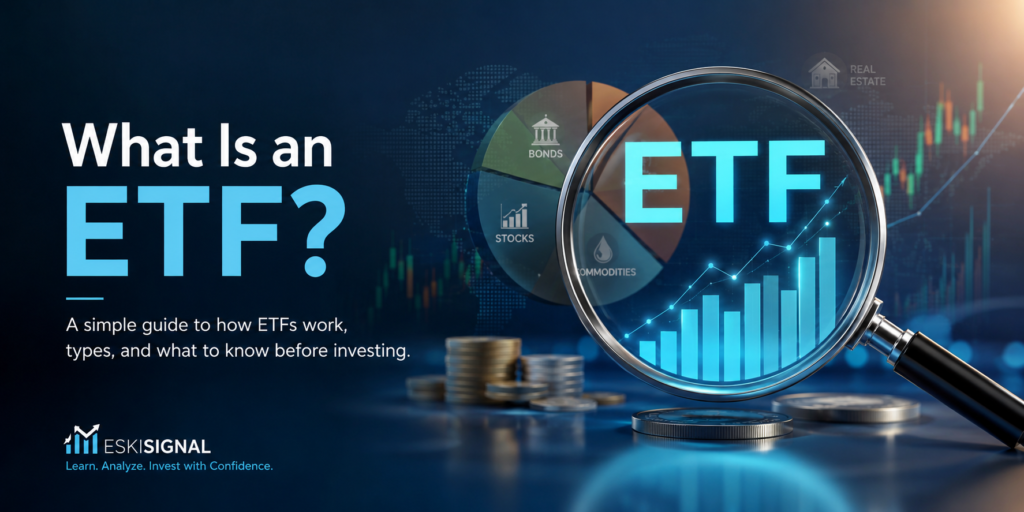
An ETF, or exchange-traded fund, is a basket of investments — such as stocks, bonds, or other assets — that trades on a stock exchange like a single stock. When you buy one ETF share, you get proportional exposure to everything the fund holds. ETFs are popular because they offer diversification in a single trade, usually have lower fees than traditional mutual funds, and can be bought or sold throughout the trading day at market prices. This is an educational overview of how ETFs work, not advice about any specific fund.
How an ETF works
- It holds a basket: an ETF owns a collection of underlying assets, often tracking an index.
- It trades intraday: unlike mutual funds (priced once a day), ETF shares trade live on an exchange.
- It has a ticker: each ETF has a symbol, like a stock.
- Creation/redemption: large institutions create or redeem shares to keep the ETF’s price close to the value of its holdings (its NAV).
Common types of ETFs
| Type | What it holds | Example use |
|---|---|---|
| Index ETFs | Stocks tracking an index (e.g., S&P 500) | Broad market exposure |
| Sector ETFs | Stocks from one sector | Targeted exposure |
| Bond ETFs | Government or corporate bonds | Fixed-income exposure |
| Dividend ETFs | Dividend-paying stocks | Income focus |
| Option-income ETFs | Stocks plus an options strategy | Higher, variable distributions |
ETF vs mutual fund vs stock
| Feature | ETF | Mutual fund | Single stock |
|---|---|---|---|
| Trades intraday | Yes | No (end-of-day) | Yes |
| Diversified | Usually | Usually | No |
| Typical fees | Often low | Often higher | None (per fund) |
| Minimum | One share | Often a set minimum | One share |
What to check before looking at any ETF
Reading an ETF starts with its official documents. The key items to verify are the expense ratio (annual fee), what the fund actually holds, how it is structured, any distribution schedule, and the risks named in the prospectus. For more complex ETFs — like option-income funds — the structure matters a lot, because the way returns and distributions are generated differs from a plain index fund.
Why distribution ETFs need extra care
Some ETFs are built to pay high distributions using options strategies. Their headline “yield” is often annualized from recent variable payouts, which can overstate stability, and their share value (NAV) can erode over time if distributions exceed what the strategy sustainably generates. A high distribution rate is not the same as total return. This is exactly why the fund’s prospectus and distribution history matter more than a single yield number.
Where ETFs show up on EskiSignal
- SCHD Dividend History — a dividend-focused index ETF.
- YMAX Dividend History — an option-income fund-of-funds ETF.
- JEPQ Dividend History — an equity premium income ETF.
Mini glossary
| Term | Plain-English meaning |
|---|---|
| NAV | Net asset value — the per-share value of the fund’s holdings |
| Expense ratio | The annual fee charged by the fund, as a percentage |
| Index | A benchmark basket the ETF may track |
| Distribution | Cash the ETF pays out to shareholders |
| Creation/redemption | How shares are added or removed to track NAV |
Risks, uncertainty, and limits
- ETFs carry market risk; their value can fall as well as rise.
- Complex ETFs (e.g., leveraged or option-income) have distinct risks; read the prospectus.
- A low fee does not guarantee good performance.
- This is educational content, not advice about any fund.
What this article does not conclude
This explainer defines ETFs and how they work. It does not recommend any fund or predict performance.
What is an ETF in simple terms?
An ETF (exchange-traded fund) is a basket of investments that trades on an exchange like a single stock. One share gives you proportional exposure to all the fund’s holdings.
What is the difference between an ETF and a mutual fund?
ETFs trade throughout the day on an exchange at market prices and often have lower fees, while mutual funds are priced once per day after the market closes.
Are ETFs safe?
ETFs carry market risk and can lose value. Broad index ETFs are diversified, but complex ETFs (leveraged or option-income) have additional risks. Always read the prospectus. This article does not give investment advice.
Why do some ETFs have very high yields?
Some ETFs use options strategies to pay large, variable distributions. Headline yields are often annualized and can overstate stability, and the fund’s NAV can erode if distributions exceed what the strategy sustainably generates.
Sources
- U.S. Securities and Exchange Commission — investor education on ETFs.
- General market references on ETF structure and mechanics.